
By Renae Rodgers
Current Population Survey (CPS) data collection and processing were among the many U.S. government programs and services interrupted by the October 1-November 12, 2025 U.S. government shutdown. This blog post gives an overview of the impacts of the 2025 government shutdown on CPS data collection and processing, explores how missed data collection in October and delayed data collection in November due to the shutdown impacted CPS response rates, and discusses implications for the CPS panel component.
Data Collection and Processing
The Current Population Survey is one of two surveys used to create the Employment Situation News Release published every month by the Bureau of Labor Statistics (BLS); the CPS is commonly referred to as the “household survey” in these releases. Each month they are in the CPS, household respondents are asked questions on work and job search activities for members of their households during the week that includes the 12th of the month – this is known as the “reference week” (Bureau of Labor Statistics, 2025a). CPS households are interviewed during the week immediately following the reference week – the week that contains the 19th. Data collection lasts for approximately 10 days. During November and December, reference weeks and subsequent data collection may be moved one week earlier if necessary to avoid coinciding with holiday periods. The Employment Situation news releases are typically published the first Friday of the month following data collection (e.g., the August Employment Situation news release is the first Friday of September) and the Public Use Microdata files are typically published the Wednesday following the Employment Situation news release.
The 2025 government shutdown impacted data release, collection, and processing in unique ways. Figure 1 shows the CPS reference weeks for September through December of 2025, the CPS interview weeks for this same period, and the days on which the federal government was shut down.
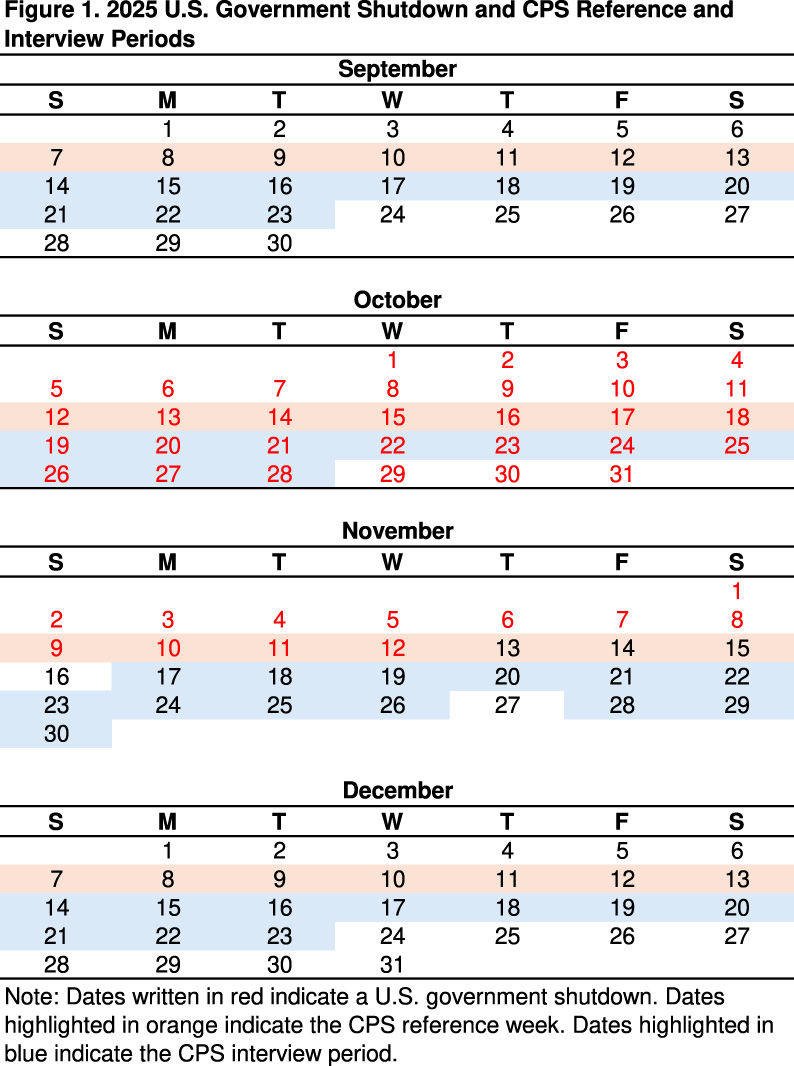
The Bureau of Labor Statistics has described the impact on CPS data for September through November of 2025 as follows (Bureau of Labor Statistics, 2025b):
- September CPS data were collected as usual, but the government shutdown delayed their release. The September data should have been released on October 8, 2025 but they were not publicly available until November 20, 2025.
- The entirety of October 2025, including the CPS reference and interview weeks, coincided with the government shutdown. No CPS data were collected in October 2025 and the BLS has indicated that these data will not be collected retroactively.
- The shutdown period overlapped with part of the November CPS reference week and delayed the beginning of data collection by one day (beginning November 17, 2025 instead of November 16, 2025). However, to account for the increased interview burden (see next section) and to accommodate the Thanksgiving holiday, data collection for November was extended through the end of the month.
To our knowledge, December CPS data collection is proceeding on a normal schedule.
No official announcements have been made by the BLS or the Census Bureau regarding the impact of the government shutdown on CPS supplement data. However, the CPS Education Supplement data has historically been collected in October and this supplemental survey was also scheduled to be fielded in October of 2025. CPS topical supplement surveys are asked at the same time as the Basic Monthly Survey; as a result, we are confident that no education supplement data was collected in October of 2025.
Implications for the CPS Panel
The Current Population Survey has a rotating panel design wherein households1 are eligible to be interviewed eight times – they are interviewed for four consecutive months, rotate out of the survey for the next eight months, and are interviewed for a final four consecutive months before exiting the sample for good. Each month, a new cohort enters the panel. A household’s place in this 4-8-4 rotation pattern is referred to as the household’s “month-in-sample”, or MIS (available in IPUMS CPS through the MISH variable). A household’s MIS value is the number of times a household has been eligible to participate in the CPS; MIS values of one through four are assigned in the first set of interviews, and interviews after the eight-month break have MIS values of five through eight. The first CPS interview (i.e., MIS 1) is generally conducted in-person, as is the fifth interview (i.e., MIS 5) when households are re-entering the panel after the eight-month break.
The never-collected October CPS data creates a gap in the monthly data series and a disruption in the longitudinal panels that can be created by linking individuals across months. Though no data was collected in October, the CPS 4-8-4 rotation pattern continues un-interrupted, creating missing observations in panels for some households.
Figure 2 shows overlap between the October 2025 CPS sample for whom data was never collected and the September and November 2025 CPS samples. The CPS 4-8-4 panel design is implemented as would have been expected without a government shutdown: 75% of the households who would have been a part of the October 2025 CPS sample are also eligible to be interviewed for the November 2025 CPS sample.
Put simply: MIS values continue to be assigned as they would have been if October data were collected. For example, households that had MIS values 1-3 and 5-7 in September should have had their fourth and eighth interviews, respectively, in October. Households scheduled to be interviewed for the first or fifth time in October are given their second (MIS = 2) and sixth (MIS = 6) interviews, respectively, in November.
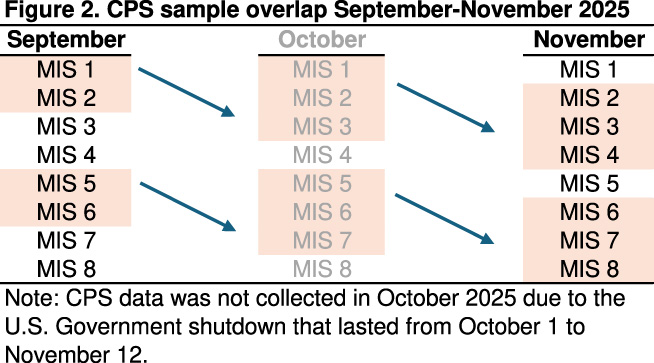
Because data from October 2025 is missing, the following linkages will not be possible.
- Month-to-month linkages: It will be impossible to create a month-to-month link using September-October or October-November of 2025.
- Year-to-year linkages: It will also be impossible to create year-to-year links for the month of October for 2024-2025 and 2025-2026.
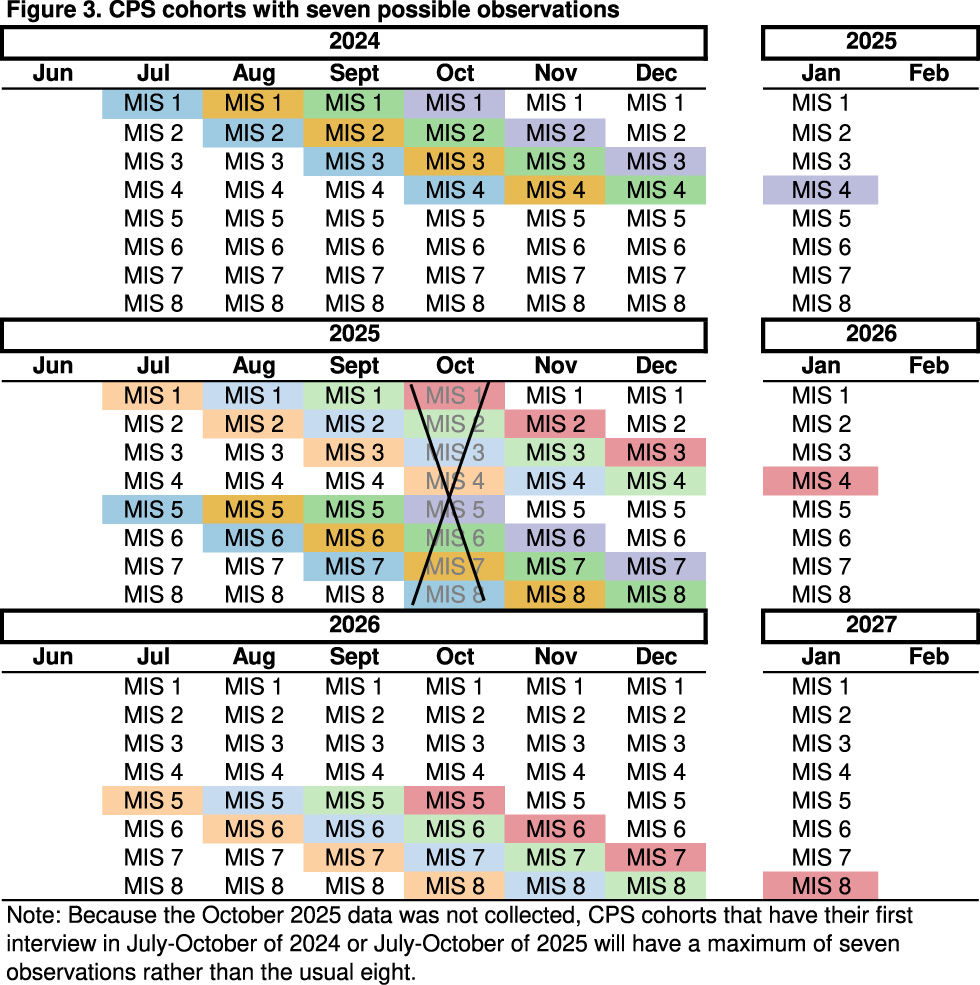
- Full panel linkages: The eight CPS cohorts that were eligible to be interviewed in October 2025 will have a maximum of seven observations in the data. Households that enter the CPS in July, August, September, or October in 2024 or 2025 will only be observable seven times in the CPS data. As shown in Figure 3, the cohort entering the CPS in July 2024 would have had their MIS 8 observations collected in October 2025, but these data are missing. Similarly the cohorts entering in August, September, and October 2024 are missing their MIS 7, 6, and 5 values, respectively, and cohorts that enter the CPS in July-October of 2025 are missing their MIS 1 through 4 observations, respectively. Due to the structure of the CPS rotation pattern, the impacts of a single missing month impact CPS panels spread across four calendar years.
Response Rates
Current Population Survey response rates, as with many after federal surveys, have been declining over time (Czajka & Beyler, 2016; American Statistical Association, 2025). This trend has accelerated since the COVID-19 pandemic however, November 2025 CPS response rates represent a new low (see Figure 4). At 64%, the November 2025 response rate is even lower than the rate for June 2020, which represented the low point of CPS response during the COVID-19 pandemic.
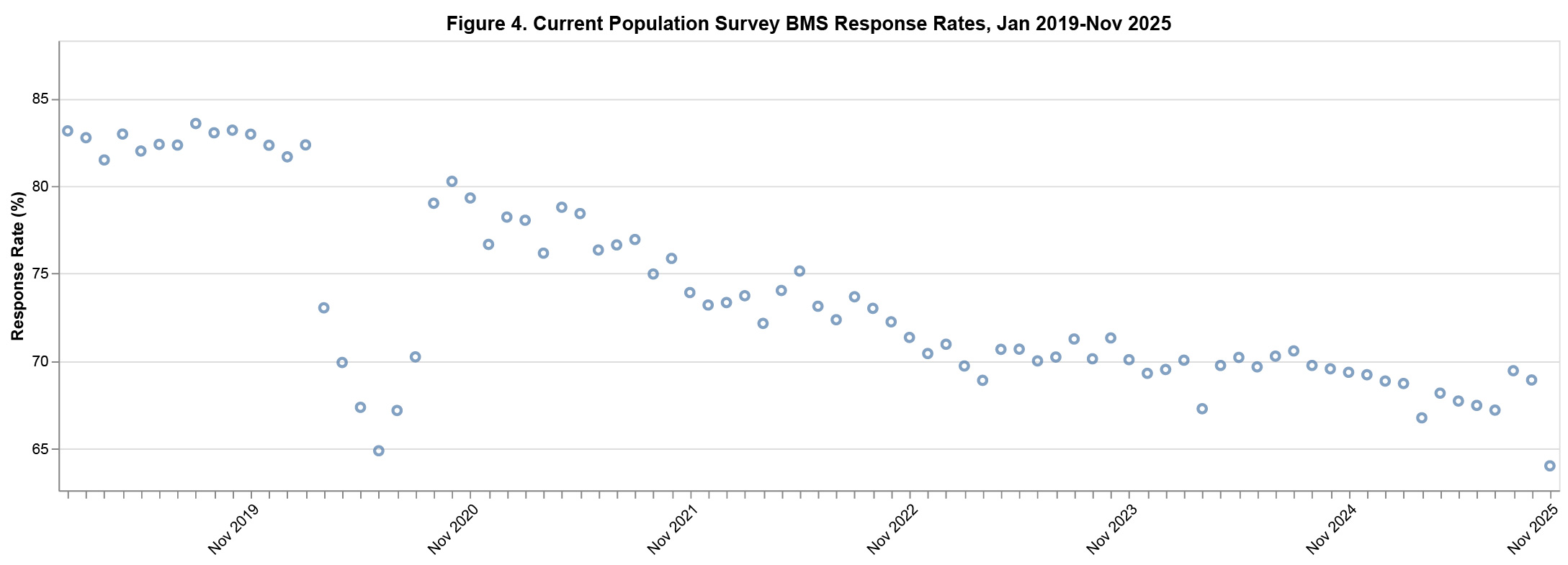
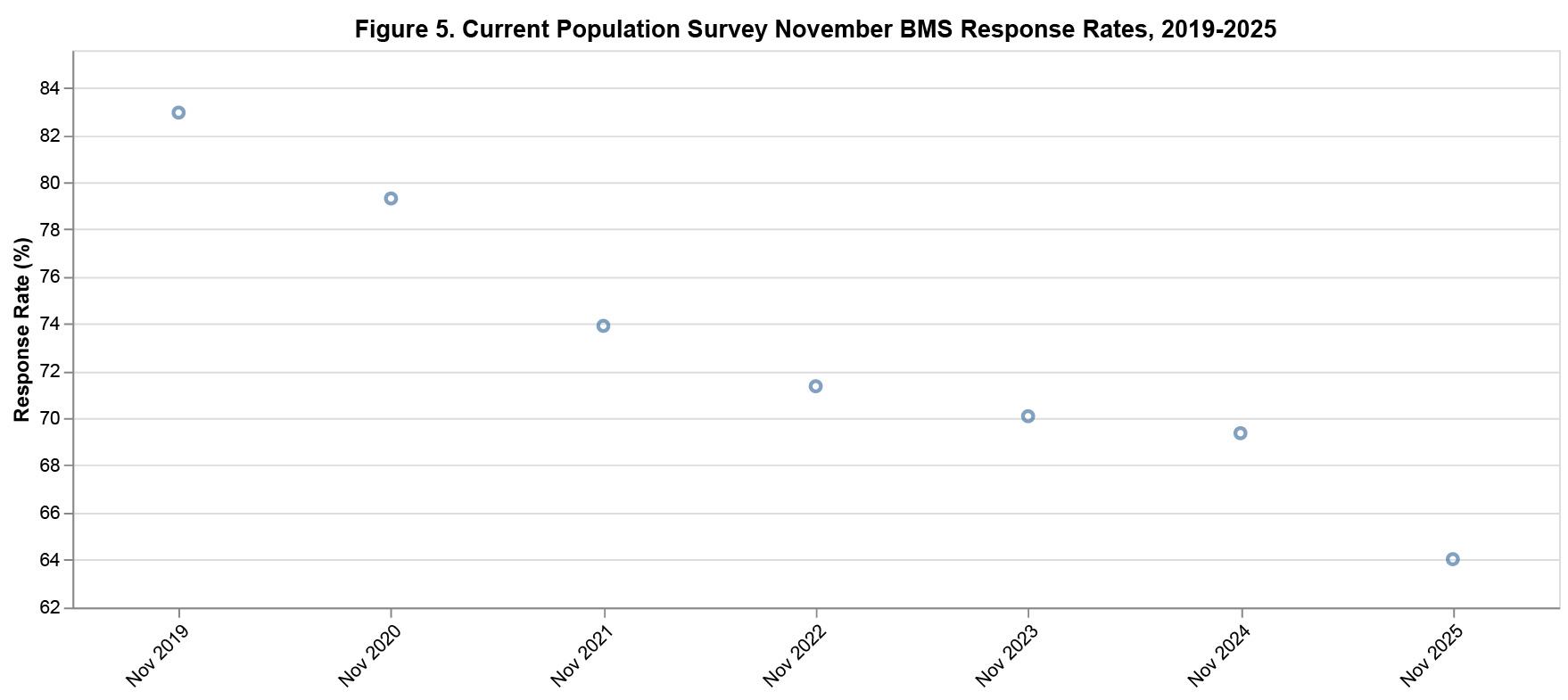
There is some seasonal variation in CPS response rates, however even when comparing response rates from the same month across years (See Figure 5), November of 2025 represents a sizable drop in CPS response.
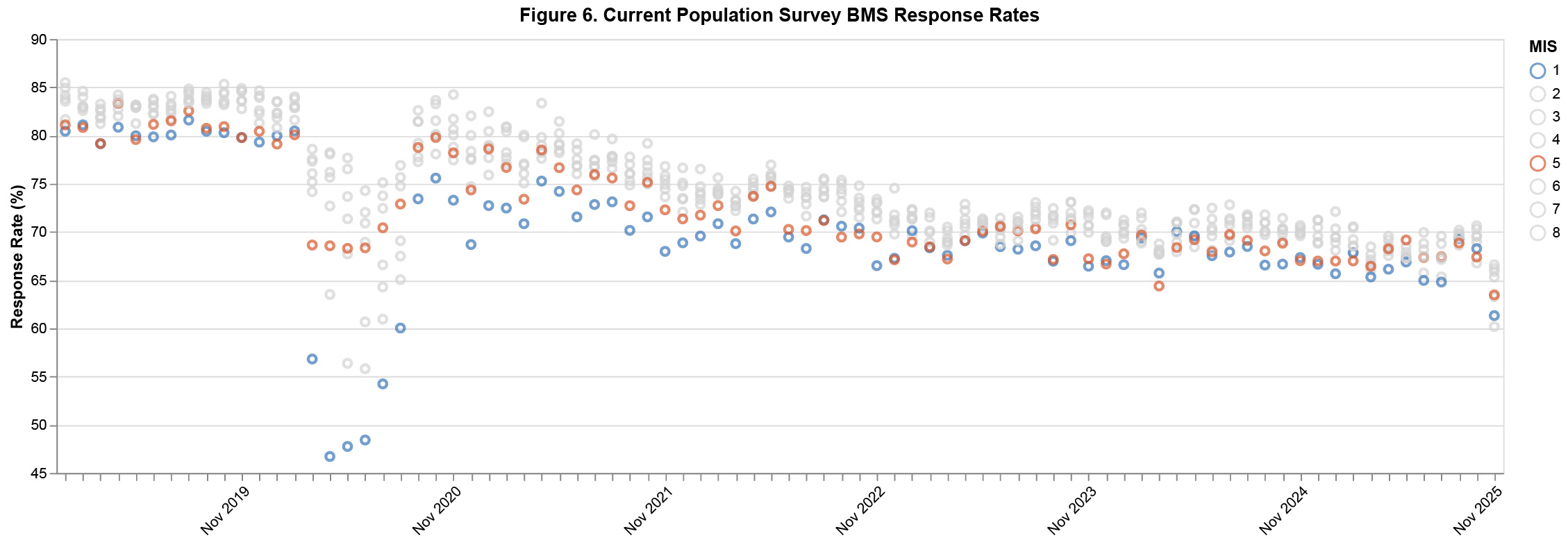
Among households sampled for the CPS in any given month, response rates tend to be lowest among those households first entering the CPS sample (MIS 1) and those re-entering the CPS sample after the eight-month break (MIS 5) (See Figure 6).
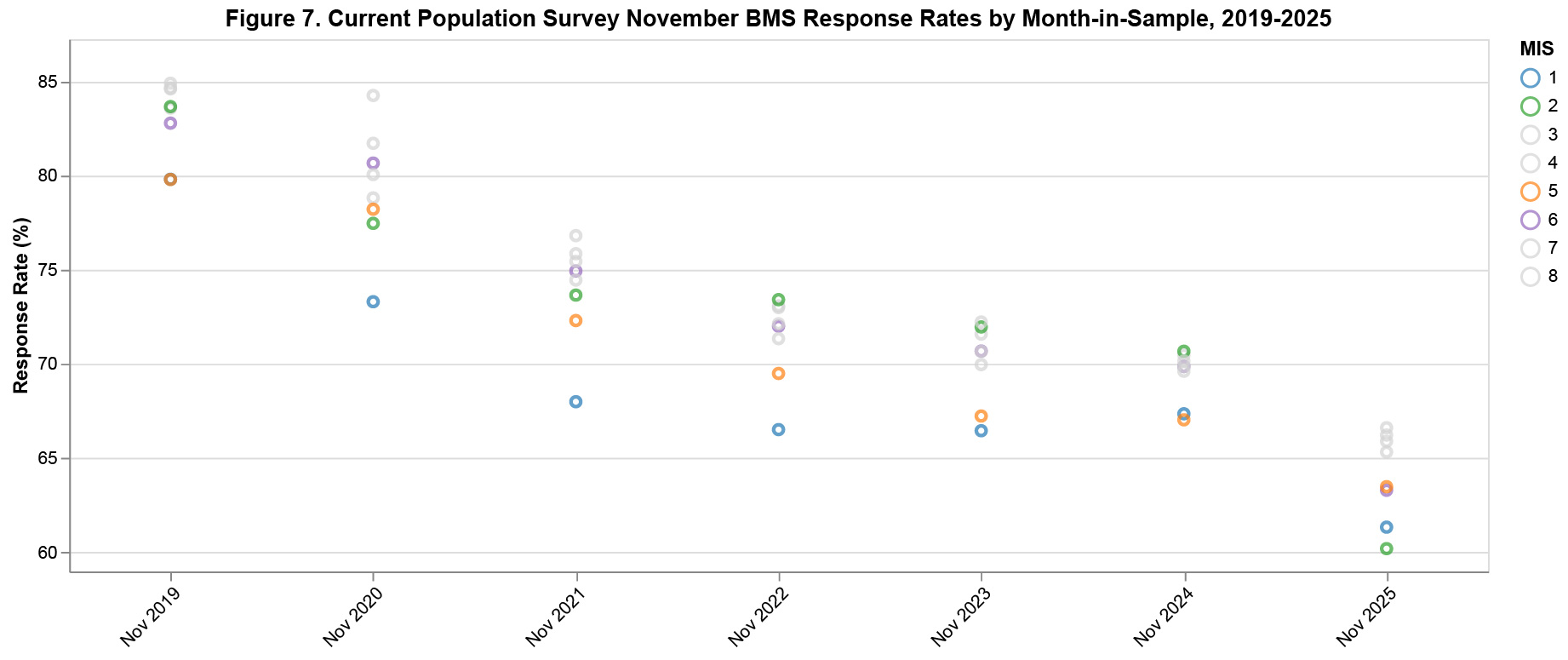
While the cohort entering the CPS in October 2025 will be assigned to MIS 2 in November 2025, the November 2025 data collection represents their first CPS interview. Likewise, the CPS cohort that would have re-entered the survey after the eight-month break in October 2025 will be in MIS 6 in November, but their re-entry now follows an effective nine-month break. The response rates of these late-entering and late-returning CPS cohorts in November of 2025 have low response rates similar to those entering and re-entering cohorts in other months. As seen in Figure 7, response rates among MIS groups 2 and 6 are much more similar to those of MIS 1 and MIS 5 groups in November 2025 than in this month in previous years when data collection was not interrupted.
The delay and resulting extension of November data collection may be partially responsible for the low overall response rate and especially low response rate among new and returning cohorts. Usually, CPS data collection in November is done before the Thanksgiving holiday. However, in 2025, November data collection was extended until the end of the month. Even though no interviews were conducted on Thanksgiving day, holiday travel and activities during this week may have made households more difficult to contact or, when contacted, less inclined to respond.
Missing CPS Data in Context
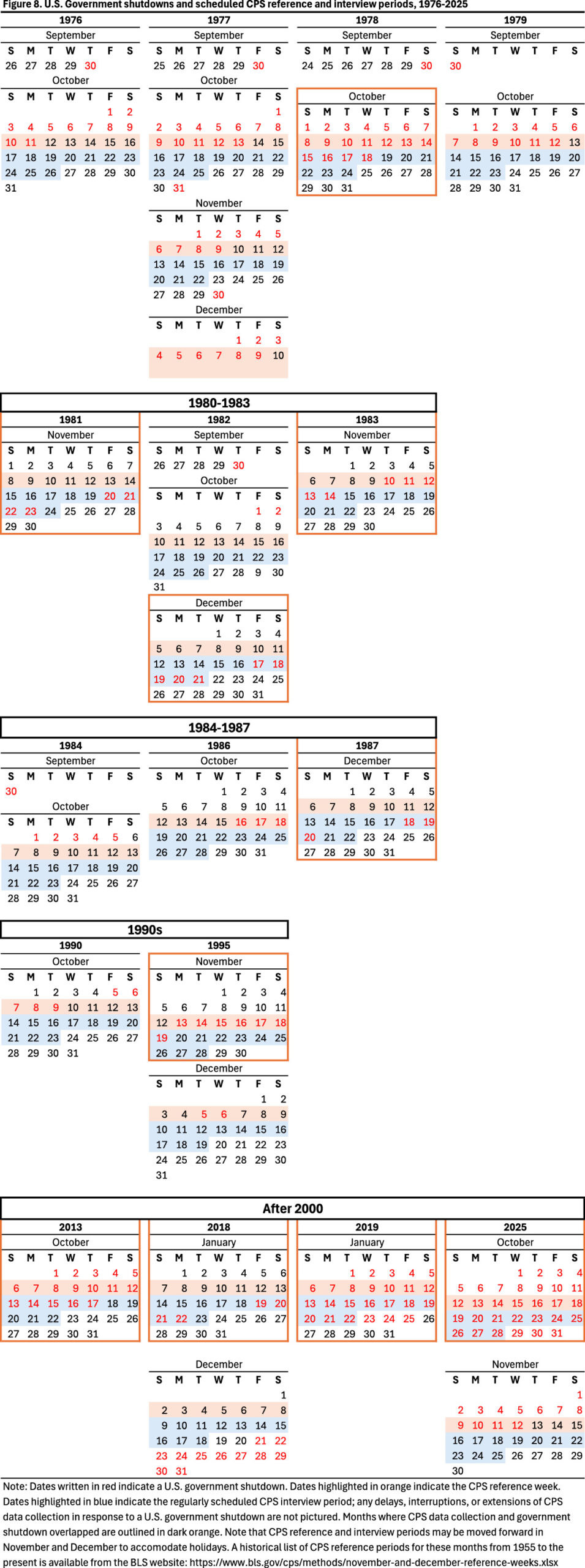
October 2025 is the first and only gap in the publicly available monthly CPS series going back to January 1976. Despite the long history of US federal government shutdowns, this is the first time that monthly CPS data were simply not collected. Government shutdowns have, in fact, overlapped with the CPS BMS collection period ten times2 in the past 49 years. Figure 8 shows dates of U.S. government shutdowns from 1976-2025 in relation to CPS reference weeks and data collection periods. The only other time that a federal government shutdown has overlapped with the CPS data collection period entirely was in January of 2019, however, during this lapse in appropriations, the Bureau of Labor Statistics remained funded and data collection proceeded as usual (Bureau of Labor Statistics, 2019). During other shutdowns that overlapped with the CPS interview period, data collection was extended to accommodate interruptions or delayed starts as needed3 (Bureau of Labor Statistics, 2018, 2013, 1995, 1987, 1983, 1982, 1981, 1978).
The CPS basic monthly data are essential. Their quality and timeliness have been unfailing for nearly 50 years. It is no wonder that they are a cornerstone of US data infrastructure and instrumental to impactful policy and research that benefits the US and its residents. We can create documentation and share resources for navigating disruptions to this vital data source, but the data themselves are irreplaceable (O’Trakoun, 2025; Kolko, 2025). If you rely on CPS data in your work, know that IPUMS will continue to keep you updated on CPS data developments and work to provide harmonized versions of these data as quickly as we can.
References
Bureau of Labor Statistics (2025, December 11). Concepts and Definitions (CPS). https://www.bls.gov/cps/definitions.htm#refweek
Bureau of Labor Statistics (2025, December 16). 2025 federal government shutdown impact on the Current Population Survey. https://www.bls.gov/cps/methods/2025-federal-government-shutdown-impact-cps.htm
Bureau of Labor Statistics (2019, February 1). The Employment Situation – January 2019. https://www.bls.gov/news.release/archives/empsit_02012019.pdf
Bureau of Labor Statistics (2018, February 2). The Employment Situation – January 2018. https://www.bls.gov/news.release/archives/empsit_02022018.pdf
Bureau of Labor Statistics (2013, November 8). The Employment Situation – October 2013. https://www.bls.gov/news.release/archives/empsit_11082013.pdf
Bureau of Labor Statistics (1995, December 8). The Employment Situation – November 1995. https://www.bls.gov/news.release/archives/empsit_11082013.pdf
Bureau of Labor Statistics (1988, January 8). The Employment Situation – December 1987. https://fraser.stlouisfed.org/title/employment-situation-144/december-1987-56001
Bureau of Labor Statistics (1983, December 2). The Employment Situation – November 1983. https://fraser.stlouisfed.org/title/employment-situation-144/november-1983-56164
Bureau of Labor Statistics (1981, December 4). The Employment Situation – November 1981. https://fraser.stlouisfed.org/title/employment-situation-144/november-1981-56147
Bureau of Labor Statistics (1978, November 3). The Employment Situation – October 1978. https://fraser.stlouisfed.org/title/employment-situation-144/october-1978-497007
O’Trakoun, J. (2025, December 16). Phantom Figures: Missing Data in October. Federal Reserve Bank of Richmond. https://www.richmondfed.org/research/national_economy/macro_minute/2025/phantom_figures_missing_data_in_october
Kolko, J. (2025, October 30). What the government shutdown teaches us about private sector data. Peterson Institute for International Economics. https://www.piie.com/blogs/realtime-economics/2025/what-government-shutdown-teaches-us-about-private-sector-data
Czajka, J; Beyler, A. (2016, June 15). Declining Response Rates in Federal Surveys: Trends and Implications. Mathematica Policy Research. https://aspe.hhs.gov/sites/default/files/private/pdf/255531/Decliningresponserates.pdf
Bowen, C.; Citro, C.; Crosby, M.; Pierson, S.; Potok, N. Seeskin, Z. (2025). The Nation’s Data At Risk: 2025 Report. The American Statistical Association. https://www.amstat.org/docs/default-source/amstat-documents/the-nations-data-at-risk-2025/The-Nations-Data-at-Risk-2025-Report.pdf
Footnotes
- Note that the CPS samples addresses, not the people who live at those addresses. If one or all members of a household living at a sampled address move during the CPS rotation, the individuals are not surveyed at their new address.
- October 1978, November 1981, December 1982, November 1983, December 1987, November 1995, October 2013, January 2018, January 2019, and October 2025.
- BLS Employment Situation releases from December 1987, November 1983, December 1982, November of 1981, and October of 1978 do not make any reference to impacts of government shutdowns on data collection, but as CPS data has long been available for these months, it is clear that any impact was not fatal to data collection and publication.