
By Sarah Flood and Isabel Pastoor
Which weight should I use for my analysis?
One of the most common questions IPUMS users ask us is “which weight should I use for my analysis?” The real answer is “it depends.” Unfortunately, there is no hard and fast rule.
There is a lot of variability in the number of weights across IPUMS US Microdata collections. In some cases, there aren’t too many options. For example, in modern IPUMS USA data there are two weights – HHWT and PERWT – to choose from and which one you use depends on whether you’re doing a household-level analysis or a person-level analysis. In other cases, there are many more weights to choose from and recommending a weight requires additional information about what variables and datasets researchers are using to answer their questions. Consider the complexities of other US Microdata collections:
- IPUMS CPS: The Current Population Survey (CPS) basic monthly survey has both a household, person, and earning weight. In addition, nearly every supplement fielded alongside the CPS has its own weight. Analyses that include variables collected as part of supplements should use the supplement weight because every CPS participant does not respond to every supplement.
- IPUMS ATUS: In addition to the standard annual weight, every American Time Use Survey (ATUS) module has its own weight. Like the CPS, not every ATUS respondent participates in every module, which is why the module weight should be used.
- IPUMS NHIS: In the National Health Interview Survey (NHIS), the appropriate weight depends on the specific NHIS source files of the variables you are analyzing and your focal population(e.g., adults or children). A major redesign in 2019 changed the appropriate weight for otherwise comparable variables, and many years include additional supplement weights.
- IPUMS MEPS: Only person-level weights are available since the Medical Expenditure Panel Survey (MEPS) includes no household-level variables. A number of module- or questionnaire-specific weights are also available.
How does IPUMS help users figure out which weight they should use?
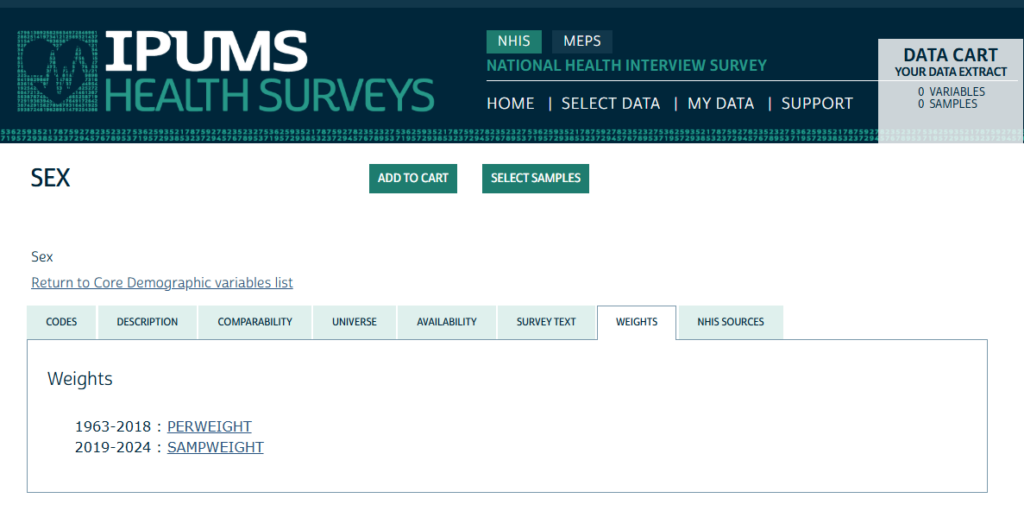
A very useful, but understated feature of IPUMS is the “weights” tab in variable descriptions for IPUMS NHIS, IPUMS MEPS, and IPUMS ATUS (and IPUMS CPS is coming soon!). The “weights” tab communicates the recommended weight for each dataset (i.e., year in the NHIS case). Figure 1 is a screen shot of the IPUMS NHIS variable SEX. In the 1963 to 2018 period, PERWEIGHT is the appropriate weight for analyses. In the 2019 to 2024 period, SAMPWEIGHT is the appropriate weight for analyses.
Figure 1. Weights Tab in IPUMS NHIS Variable SEX
What else should I be thinking about regarding weights?
- If the variables in your dataset have different recommended weights, use the most restrictive one. For practical illustrations of what this means, see the following posts and replies by IPUMS staff on the IPUMS User Forum: example 1 (sample adult and supplement weights in NHIS); example 2 (CPS supplement weights); example 3 and example 4 (baseline weights for CPS linking).
- Household-level analyses should use household weights, while person-level analyses should use person weights. Both household and person weight variables are provided for most IPUMS microdata collections. An example of a household-level analysis is an estimation of median household income. An example of a person-level analysis is an estimation of the share of persons who live in households with household income above a certain threshold. For household-level analyses, remember to restrict the sample to just one person per household so that households are not counted multiple times.
- When analyzing data from multiple pooled samples, estimates of frequencies will be inaccurate unless weights are adjusted for pooling. A general rule of thumb is to divide the weight variable by the number of pooled samples to obtain accurate frequency estimates that constitute an average across the entire time period represented. Linear transformations of weights are not necessary for, nor do they affect, non-frequency estimates (e.g., proportions, regression coefficients).
- While applying sampling weights generally makes estimates representative of the sampled population, not all samples are constructed to be representative of small geographic areas. Conversely, some samples are constructed to be representative of certain geographic areas or levels, but are not nationally representative. Be sure to review the sample design documentation for each sample you use, and any documentation for geography variables you use.
- Microdata provide enormous flexibility for identifying a population of interest, but it is always important to ensure that the unweighted sample size (i.e., the number of cases you are using to make a population inference) is reasonably sized. There is no bright-line rule for “too small to study,” but generally single- and even some double-digit sample sizes are considered too small to produce reliable estimates.
- Many weights are “preselected” variables, meaning they will automatically be included in your IPUMS data extract (unless you remove them). But other weights must be added manually. Make sure you’ve included all the weights you need for your analysis in your data extract.
- More information on weights for individual IPUMS data collections is available in the User Guide (on the left-hand menu of IPUMS data collection homepages). For a quick primer, read our blog post on sample weights.
- If you aren’t sure which weight to use, reach out to us and ask! You can email IPUMS User Support at ipums@umn.edu or post in the IPUMS User Forum and one of our staff members will reply.