
By Miriam L. King, Anna Bolgrien, & Julia Rivera Drew
Mental health conditions, such as depression and generalized anxiety disorder, are an important aspect of population health around the world. Including measures of mental health conditions in population health surveys is important for elucidating overall wellbeing. For example, a 2025 IPUMS Best Student Paper winner used data from the IPUMS-harmonized National Health Interview Survey (NHIS) and Medical Expenditure Panel Survey (MEPS) to document increasingly poor self-rated health among young adults in the U.S., largely due to an increase in the prevalence of poor mental health.1 While mental health measures have long been included in U.S. health surveys such as the NHIS, the Demographic and Health Surveys (DHS) and the UNICEF Multiple-Indicator Cluster Surveys (MICS) have recently incorporated measures of mental health comparable to those found in the NHIS.
This blog post will identify new opportunities for the comparative study of mental health by highlighting some of the widely available measures of depression and anxiety in the U.S. NHIS and in international population health data sources available from IPUMS. Which mental health measures to use will depend on the research question and the population of interest. Diagnosis-focused measures ask whether a person was (ever) told by a health professional that they have a certain mental health condition. Symptom-focused approaches ask about recent symptoms associated with mental health conditions, often using validated scales. Symptom-focused queries give a more accurate view of the prevalence of mental health problems, particularly in settings where medical and mental health resources are sparse, so few people are diagnosed.
The US Context: NHIS
The NHIS has gathered detailed mental health measures for adults for many years. This effort includes annual collection for 1997-2018 (and rotating collection for 2019-forward) of both diagnosis-focused measures (e.g., DEPRESSEV), and symptom-focused measures (e.g., the six components of the Kessler 6 Scale). In 2019, the NHIS began fielding, on a rotating basis, the Patient Health Questionnaire depression scale (PHQ) that is frequently used to screen for depression in both clinical settings and population-based studies. In addition to measures of prevalence, the NHIS includes questions about the frequency, intensity, and duration of diagnosed mental health conditions or self-reported symptoms. Other parts of the survey capture whether mental health conditions caused an activity limitation, whether respondents took medication for a mental health condition, whether they used complementary and alternative medicine for depression, and whether they needed but couldn’t afford mental health care.
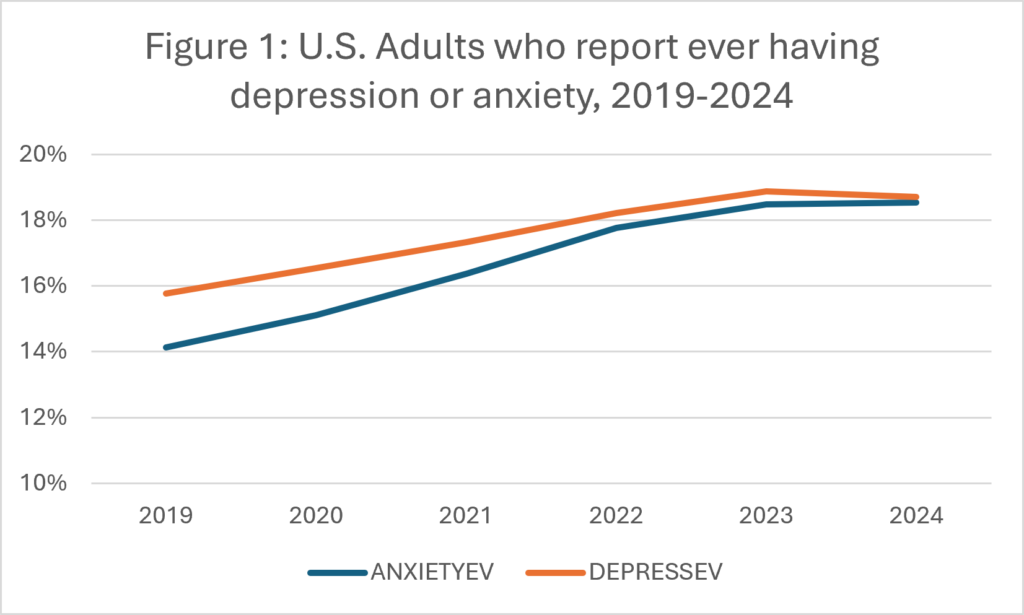
The inclusion of questions related to depression and anxiety for several years in NHIS allows us to track trends in prevalence for mental health condition in the United States. For example, Figure 1 plots the increasing percentage of U.S. adults who ever had depression or were ever told they had any anxiety disorder from 2019 to 2024, based on data from IPUMS NHIS (using weighted counts, with adjustment for the complex survey design of the NHIS).
The Global Context: DHS and MICS
Starting in 2022, the DHS and MICS offered the option of including an adult mental health module, which covered depression and generalized anxiety disorder. Four 2022 surveys in IPUMS DHS, for Bangladesh, Kenya, Mozambique, and Nepal, included the mental health questions for women of childbearing age; the surveys in Nepal and Mozambique collected mental health information from adult men (to be released by IPUMS DHS in the coming year). In addition, questions about depression and anxiety were part of an optional battery of questions in IPUMS DHS about chronic disease in adults. Two 2024 IPUMS MICS surveys, from Nepal and Kazakhstan, have mental health information for young adult women and men. Such content was an innovation in the latest rounds of DHS and MICS surveys and will be included additional DHS surveys in future.
The IPUMS DHS variables ANXIETYDIAG and DEPRESSIONDIAG report whether the respondent was ever diagnosed with anxiety or depression. IPUMS DHS variables on anxiety and depression diagnosis include limited follow-up questions about current treatment and help-seeking. Symptom-focused questions in the DHS for depression consist of nine questions, covering issues such as feelings of sadness and worthlessness and thoughts of self-harm; the answers are scored in the summary variable DEPRESSIONSCORE. The depression questions come from the PHQ. The DHS questions on generalized anxiety disorder have a similar structure, with a 2-week reference period, seven questions about symptoms, such as worrying and restlessness, and a summary score in GADSCORE. The NHIS includes corollary measures for both PHQ measures (e.g., PHQBAD) and GADSCORE (e.g., GADRELAX2WK).
It is not yet possible to study time trends for mental health problems using the global health data, but we can study variation across countries. For example, according to the IPUMS DHS data, the proportion of women of childbearing age who had ever been diagnosed with anxiety by a health care professional was 2 percent for Kenya and Mozambique, 4 percent for Nepal, and 8 percent for Bangladesh in 2022. Results from a question about women ever having been diagnosed with depression similarly show cross-country variation and low prevalence: 1 percent for Benin 2017 and Cameroon 2018, 2 percent for Madagascar 2021, and 3 percent for Kenya 2022. Clearly the prevalence of mental health diagnoses is shaped by both the availability of medical care and the recognition of anxiety and depression as health problems across countries.
Children’s Mental Health
While there are many more mental health measures available for adults, NHIS, MEPS, and DHS also collect some data on children’s mental health. NHIS regularly fields the Strengths and Difficulties Questionnaire (SDQ) for children age 4-17 (see IPUMS NHIS variable WORRIED). The SDQ has both a “brief” questionnaire focused on emotional symptoms and an “extended” version that also covers conduct problems, hyperactive behavior, peer relationships, and prosocial behavior. Questions about child mental health are currently more sparse in the global health surveys. Specifically, IPUMS DHS includes a single variable about depression (DEPRESSFREQ) in children age 2-4, and IPUMS MICS has individual variables about anxiety (ANXIFREQ) and depression (DEPRESSFREQ) in children age 5-17. Now that adult mental health is a recognized area of inquiry in DHS and MICS, we hope that more extensive data collection about child mental health will happen in future global health surveys.
(1) Christine L. Kuryla, Julie Song, Kamaryn T. Tanner, Alan A. Cohen, Sen Pei, & the Columbia Science of Health Working Group. “The Age Gradient in Self-Rated Health is Flattening: Evidence from Six Nationally Representative US Surveys.” Unpublished paper, 2025.